
Satisfactory Review: Is $39.99 Worth It?
Disclosure: Purchased personally during Early Access for approximately $18. No review key. No gifting. Opinion entirely my own. Current Steam price of $39.99 is what this review is based on.
Platform Played on: Steam (PC)
Overall Score
5 / 5 Phoenix Feathers

Buy it. If you like systems, planning, and the satisfaction of watching something you built actually work, Satisfactory will consume you in the best possible way. This is not a casual game -- but if that's what you're looking for, you're in the right place.
What Is Satisfactory?
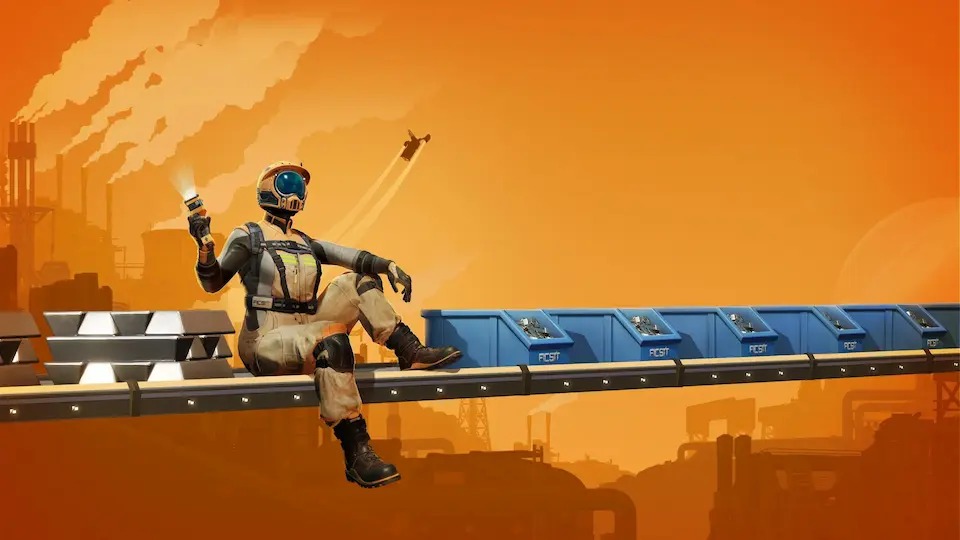
Satisfactory is a first-person open-world factory building game developed by Coffee Stain Studios. You play as a FICSIT Inc. employee dropped onto an alien planet with one objective: build a factory. Then build a bigger factory. Then build a factory that makes the first factory look like a prototype.
The game progresses through a series of FICSIT milestones that require you to research, manufacture, and deliver increasingly complex components. Every milestone unlocks new buildings, new recipes, and new problems to solve. The loop is simple on paper and bottomless in practice.
Available On
PS 5 · Epic · Steam · Steam Deck ✔ Verified
How much is actually under the hood
Does it hold up past the first playthrough
Lower score = easier to learn
How finished does it feel for the price
Does the price match the hours you'll actually get
Depth
No two factory games handle depth the same way, and Satisfactory earns its reputation on three fronts simultaneously. The world is fully 3D –– you are not pushing pieces around a flat map. You are building up, building out, routing belts through terrain, stacking floors, and eventually constructing structures that would look at home in a science fiction film. The phase-based FICSIT milestone system forces you to constantly rethink your operation –– what worked in Phase 2 is not going to survive Phase 4, and that pressure is by design. Underneath all of it is a resource chain complexity that rewards planning and punishes shortcuts. Nothing is ever just one step. Iron ore becomes iron ingots become iron plates become reinforced iron plates –– and that is before you start combining materials. The depth is not decorative. It is structural.
Replayability
Six thousand hours in and I still start new saves. That number is the argument –– but here is the why behind it.
Every run surfaces something you did wrong last time. A belt bottleneck you designed yourself into. A factory layout that made sense at Phase 1 and became a nightmare by Phase 3. The next save is where you fix it, and the fix opens three new problems you did not anticipate. That cycle does not get old.
The map compounds this. Satisfactory's world has distinct biomes, varied terrain, and multiple viable starting locations that genuinely change how a run develops. A desert start plays differently than a jungle start. The resource nodes are fixed but what you build around them is entirely yours.
Updates add a third layer. New mechanics, new milestones, new possibilities mean that a save from a year ago may not reflect what the current version makes possible. There is always a reason to go back.
Satisfactory is solo by default. Co-op is available but never required –– and that distinction matters. Your replayability is never gated behind another person's schedule. You go back when you want to go back.
Learning Curve
Satisfactory has the gentlest on-ramp in the automation genre –– and that is not a backhanded compliment. The first few hours will ask you to build things you do not fully understand yet, and that is fine. The understanding comes from building them, and when the logic clicks it clicks hard.
What makes Satisfactory accessible where other factory games are not is the community behind it. The Steam ecosystem is active, well-documented, and genuinely helpful. You are never stuck alone with a problem that nobody has solved publicly. Coffee Stain Studios has also built a game that surfaces information when you need it rather than drowning you in it upfront.
New to the genre entirely: expect a few hours of orientation before it starts flowing. Genre veterans –– especially anyone who has survived Factorio –– will find this practically a tutorial. Factorio has no ceiling and no mercy. Satisfactory has both.
The curve is real. It is also the smallest ask in its category.
Polish
Coffee Stain Studios shipped a complete game. Post-1.0 Satisfactory feels like a AAA release –– the UI is clean, the quality of life features are thoughtful, and the kind of rough edges that follow early access games into their full release are not here. The map is detailed and handcrafted. The building system is intuitive once you learn it. The performance holds up through mid-game without issue. This is a finished product by a studio that took the time to finish it.
Value
$39.99. Rarely on sale. No negotiating on the price point.
Here is the math. The gaming community generally treats $1 per hour as the benchmark for value –– anything under that and you are getting a good deal. Satisfactory will comfortably put you past 100 hours before you see the end of the content. Many players, myself included, go significantly further. At 6,000 hours my personal cost per hour is a number too small to take seriously. Even at a conservative 200 hours, you are paying $0.20 per hour.
The game does not go on sale often. It does not need to. The value is already there at full price.
Final Thoughts
Satisfactory is one of those games that is hard to explain to someone who has not played it and impossible to stop thinking about once they have. The factory building genre has no shortage of options, but Satisfactory's combination of 3D open world, phase-based progression, and genuine resource complexity puts it in a category of its own.
If $39.99 feels like a lot for a game you are not sure about, read the Steam reviews. Over 100,000 players have weighed in and the verdict there matches mine.